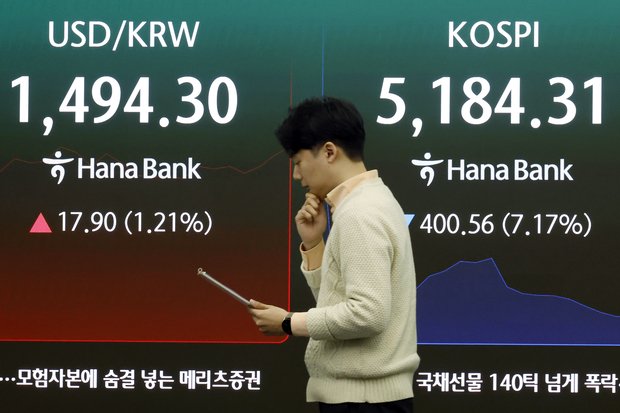

KOSPI could enter an aggressive buying zone if it reaches the 4816 level, according to analysis released Friday, with experts calling current market fears over Middle East tensions excessive.
DS Investment & Securities said Iran’s retaliatory capabilities have been structurally weakened following recent U.S. and Israeli military strikes, suggesting geopolitical risk premiums reflected in oil prices are unlikely to persist.
“There is a fundamental structural difference between wars that triggered past oil market shocks and the current Middle East situation,” analyst Yang Hyung-mo wrote in a report.
In previous conflicts, the U.S. and allies deployed hundreds of thousands of ground troops over several months, allowing Iran and Iraq to maintain physical capabilities for sporadic drone and missile attacks near the Strait of Hormuz, Yang noted.
“In this conflict, Iran’s central command structure collapsed from the moment Supreme Leader Ayatollah Ali Khamenei was eliminated, and subsequent retaliatory attacks have been scattered and uncoordinated,” he said.
Oil Premium Seen as Short-Term
“With organized counterattack capabilities already structurally neutralized at an early stage, there is no basis for uncertainty premiums to persist long-term,” Yang said.
He noted the global crude market already has a daily oversupply of 2 million barrels, with Saudi Arabia maintaining significant spare production capacity.
Historical precedent supports expectations of rapid market adjustment. During the 1991 Gulf War, international oil prices plunged approximately 33% in a single day after coalition forces launched Operation Desert Storm.
“The principle that markets immediately remove premiums once military outcomes become certain will apply equally in 2026. The difference is the speed will be faster than during the Gulf War,” Yang said.
Fear as Buying Opportunity
Yang characterized the recent domestic market correction as a potential investment opportunity.
KOSPI fell as much as 12.65% intraday on the 4th of this month, dropping to 5059—a level Yang identified as a primary buying zone. Should the index approach 4816, it would represent a secondary zone for aggressive position-building, he added.
Regarding the VIX volatility index, Yang noted: “The median peak of historical spikes is VIX 29.1, with more than half of spikes forming highs below VIX 30. Cases where VIX expanded above 30 represent 46.3% of the total.”
“The current VIX of 26.0 is at an early stage, having just exceeded the spike detection threshold. Based on historical patterns, the probability of VIX reaching 30 from current levels is 39.5%, and the probability that VIX 30 represents the spike peak is 70.6%,” he said.
“We already experienced KOSPI falling to 5,059 with a -12.65% intraday decline on the 4th. That level is a primary buying zone, and reaching 4,816 would be a secondary zone for aggressive position expansion,” Yang said. “Fear is a buying opportunity.”
Retail Liquidity Could Add ₩25 Trillion
In a separate report, DS Investment & Securities analyst Kim Hyun-ji said individual investors have room to inject additional funds into the market.
Customer deposits rose approximately ₩40 trillion between December last year and February this year, yet retail investors recorded net sales of about ₩500 billion during the same period.
However, since late February, individual buying intensity has notably increased, with net purchases of approximately ₩10 trillion confirmed.
Considering this trend and available retail funds, Kim estimated approximately ₩25 trillion in additional liquidity could flow into the market.