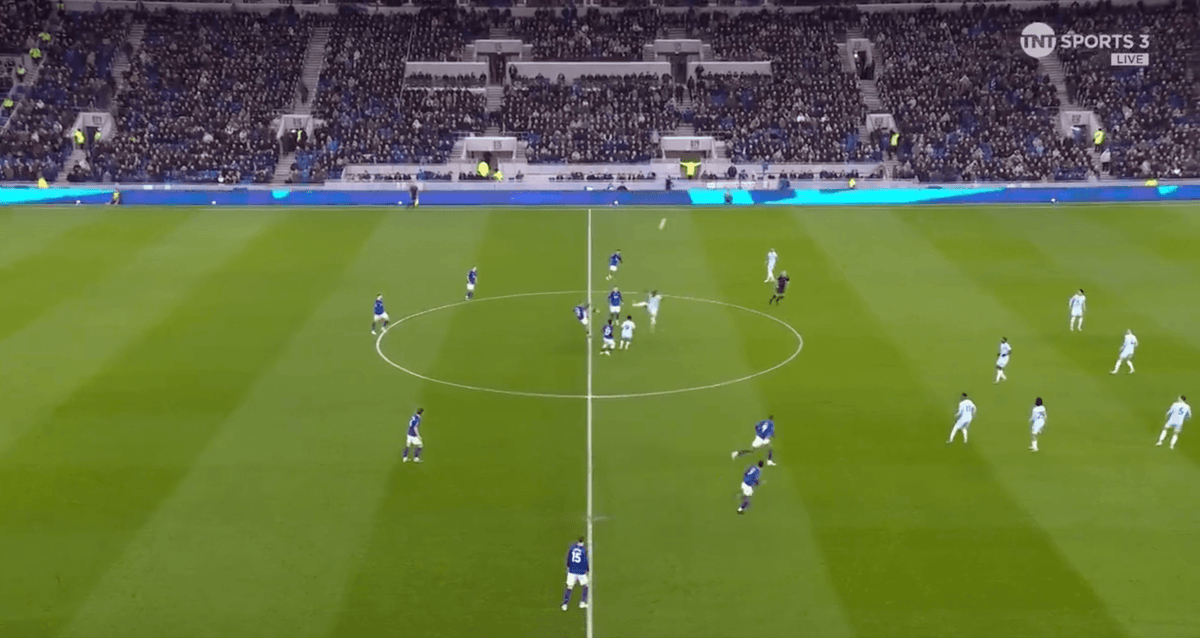
Kiernan Dewsbury-Hall was speaking to the media after Everton’s 2-0 win against Burnley on Tuesday when Rodrigo Gomes scored for Wolverhampton Wanderers against the home side’s Merseyside rivals Liverpool.
The loud cheers from fans in the concourses and corporate lounges at Hill Dickinson Stadium in response to that goal temporarily shifted attention away from the post-game debrief with broadcaster TNT Sports.
Up until that point, the focus had largely been on Dewsbury-Hall’s impressive individual performance and Everton’s aspirations to qualify for European football next season. But after a brief interlude to respond to what had happened down at Molineux, discussion turned to the former Chelsea and Leicester City midfielder’s role in one of the more bizarre moments of Tuesday’s game.
From the opening kick-off, Dewsbury-Hall had flicked the ball up and volleyed it high downfield, forcing Burnley defender Joe Worrall into an early clearance.
Everton send it sky high straight from kick off 🚀@tntsports & @discoveryplusUK pic.twitter.com/xI5HepOWGO
— Football on TNT Sports (@footballontnt) March 3, 2026
It was not the first time a Premier League side had begun proceedings in this way: Bournemouth did something similar against Newcastle United in September’s goalless draw, while Brentford’s Mikkel Damsgaard also restarted play with a volleyed ball high into the air in Tuesday’s draw against Bournemouth. And it was not Everton’s first attempt at doing so either.
Yet it remains something of a novel tactic for Premier League audiences. TNT’s clip has already amassed 1.6million views on X alone.
“Bournemouth or Brentford did it a couple of weeks ago, and it was quite good,” Dewsbury-Hall said. “We’ve actually done it the last few games.”
Addressing the former Everton and England centre-back Joleon Lescott, working as a pundit, he added: “You know as a defender that it is hard to defend when the ball is moving. (The plot is designed to) Get yourself on the front foot.
“It’s probably not the first thing I’d choose to do, but (I’ll do) whatever the gaffer (Everton manager David Moyes) says.”
“I wouldn’t want to head that,” Lescott responded in reference to the ball plummeting down from the lower stratosphere.

David Moyes appears to have taken inspiration from Bournemouth and Brentford (Paul Ellis/AFP via Getty Images)
Those quotes from Dewsbury-Hall and Lescott offer a degree of insight into a tactic that has divided opinion.
At face value, the theory involved is relatively simple. It is viewed as a way of putting the opposition under pressure from the get-go and establishing early territorial dominance. With unconventional methods such as these, there is a chance of catching defenders cold before coaches and analysts adopt ways of dealing with it.
Stuart Reid is a freelance set-piece consultant who has worked with clubs across Europe and the United States.
“I have a feeling that there are a couple of factors behind it,” he tells The Athletic. “The first is that it gives (Everton forward) Beto, who is pretty strong in the air, a chance to challenge for the ball, although he doesn’t manage to reach the defender to challenge for it in this example.
“It can provide a few good outcomes for Everton. He (the striker) could be fouled for a free kick in a dangerous location, or he could win the ball and create a chance for himself or someone else.
“The second is territory. Even if Beto loses the first aerial challenge, Everton can push their players higher up the pitch and look to intercept any clearances that could lead to a dangerous transition.
“There’s also a mental side to it. There’s no casual passing the ball around the back while both teams settle into the game. It’s high intensity — ‘We’re attacking you and pushing you within the first few seconds’.”
In the example below from Tuesday’s game, Everton right-back Jake O’Brien has pushed forward into the Burnley half and is able to recover possession from Worrall’s clearance.

The same thing happened in Saturday’s 3-2 win at Newcastle, with O’Brien seizing on Dan Burn’s clearing header.

Everton also came close to taking the lead within 30 seconds of the second half starting in the recent 1-0 defeat to Manchester United, in what was their first attempt at the new tactic.
Although Dewsbury-Hall’s long ball forward did not give striker Thierno Barry a chance to compete in the air, the midfielder regained possession from Luke Shaw’s clearance.

Play was recycled and Harrison Armstrong ended up firing a good chance too close to goalkeeper Senne Lammens after Iliman Ndiaye had wriggled free down the right.

That relative early success appears to have prompted Moyes and his coaching staff to persevere with the new kick-off method.
Other efforts elsewhere have not quite been as effective. In that September fixture against Newcastle, Bournemouth’s Alex Scott sent his kick-off straight into the arms of Nick Pope. Damsgaard’s one for Brentford on Tuesday was also claimed by Bournemouth goalkeeper Djordje Petrovic.
There is a certain irony in now Liverpool boss Arne Slot having convinced the coaching staff to try the tactic during his days as a player with Dutch side Zwolle. Slot took the kick-off himself but inadvertently sent his volley backwards, with Zwolle then losing possession.
Interesting kickoff technique from Arne Slot while he was a player in the Dutch league.
Slot got permission from Zwolle’s coaches to take kickoffs this way –though the future Liverpool manager did eventually abandon the idea after realising it wasn’t his best idea ⬇️ pic.twitter.com/zieEjeeTB9
— Daniel Taylor (@DTathletic) April 1, 2025
The move was heavily criticised in the Netherlands. “This has nothing to do with professional football,” the former international Rene van der Gijp lamented on Dutch TV show Vandaag Inside.
Former Zwolle coach Jan Everse, speaking to The Athletic on that kick-off routine, later said: “Arne has a lot of ideas — this, unfortunately, was one of his worst ones.”
Poor execution clearly amplified some of the negative reactions to the routine. But there are also those, including my colleague Michael Cox, who are concerned about the sport’s direction of travel.
Michael has highlighted what he sees as the worrying trend of teams aiming for touch from kick-off and drawn parallels with rugby union, where possession is ceded in favour of such early territorial dominance. In the column linked to above, he cites examples from Marseille’s 2018 campaign, Paris Saint-Germain’s 5-0 Champions League final win against Inter last season and Newcastle’s goalless draw at Aston Villa in August.
For some, this is a battle between the game’s pragmatism and purity. Tactics are often cyclical and repeated over time, but the current tendency is very much towards the former. Direct play is the order of the day.
The graphic below shows how kick-off routines have changed over the past six seasons. Fewer passes are going back towards a side’s own goal, with a much higher share sent deep into the opposition half.

Moyes’ Everton have been the most direct in the league in this area, with more than 80 per cent of their kick-offs ending in the final third.

That approach may not be pretty, but Moyes sees value in it.
Whether it is here to stay is debatable, and will largely depend on how quickly teams and analysts find ways of countering it.
Additional contributor: Conor O’Neill